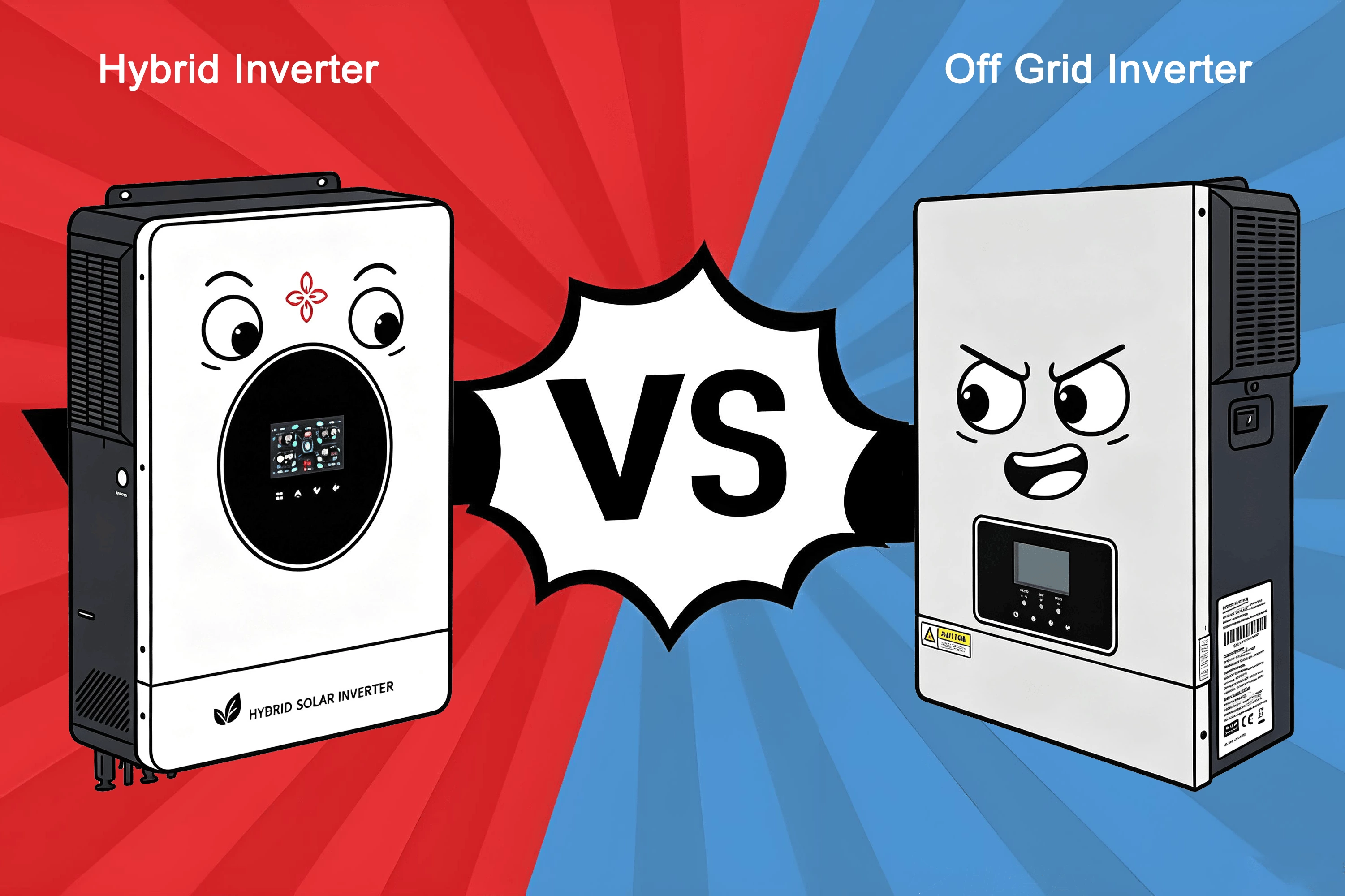
Hybrid Inverter vs Off Grid Inverter: What Is the Difference and How to Choose?
With the rapid growth of residential solar energy storage systems worldwide, choosing the right inverter has become one of the most important decision
With the rapid growth of residential solar energy storage systems worldwide, choosing the right inverter has become one of the most important decisions for homeowners, installers, and energy storage distributors.
From an engineer’s perspective, Hybrid Inverter and Off Grid Inverter may look similar because both can work with solar panels and batteries. However, they are designed for different power system architectures, application scenarios, and energy management requirements.
Let's understand the differences between them together1. What Is a Hybrid Inverter?
A Hybrid Inverter is an advanced energy management device that integrates:
- Solar PV inverter function
- Battery charging and discharging management
- Grid-connected inverter function
- Backup power control
It can intelligently manage energy flows between:solar panels (PV),battery storage,household loads and utility grid.
The main purpose of a hybrid inverter is to maximize solar energy utilization, reduce electricity costs, and provide reliable backup power.
How Does a Hybrid Inverter Work?
During the daytime:
Solar energy is generated from PV panels.
The priority energy flow is:
Solar Panels⇒Hybrid Inverter⇒Home Loads⇒Excess Solar Energy⇒Battery Storage
When the battery is fully charged:
- Excess power can be exported to the grid (depending on local regulations)
- Or controlled through an energy management system
During nighttime:
The system automatically switches energy sources:
Battery Storage⇒Hybrid Inverter⇒Home Loads
When the battery reaches a low SOC level:
Grid Power⇒Home Loads
The inverter automatically uses grid electricity to ensure stable power supply.
During power outages:
A hybrid inverter with EPS/Backup function can continue supplying power to critical loads.
Typical backup loads include:
- Refrigerator
- Internet router
- Lighting
- Security systems
- Emergency equipment
Example:
Grid Failure⇒Hybrid Inverter⇒Battery Backup⇒Critical Loads
What Is an Off Grid Inverter?
An Off Grid Inverter is designed for independent power systems where users do not rely on the utility grid.
A traditional pure off-grid system normally consists of:
- Solar Panels
- Off Grid Inverter
- Battery Storage
Its main function is:
Convert:
Solar DC power + Battery DC power
into:
Stable AC power for household appliances
How Does an Off Grid System Work?
The typical system structure:
Solar Panel⇒Off Grid Inverter⇒Battery Storage⇒Home Appliances
It operates as an independent mini power station.
Can an Off Grid Inverter Use Grid Power?
Based on engineering experience, many modern off-grid inverters are no longer limited to solar-only operation.
Some models are equipped with:
- AC Input
- Utility Charging Function
- Generator Input
These products can charge batteries through:
- Utility grid power
- Diesel generators
during periods of:
- Low solar generation
- Long rainy seasons
- High electricity demand
The actual configuration depends on the inverter design.
Key Differences Between Hybrid Inverter and Off Grid Inverter
| Comparison | Hybrid Inverter | Off Grid Inverter |
| Grid Connection | Supports grid connection | Usually independent from grid |
| Main Application | Residential storage, grid + backup systems | Remote/off-grid power systems |
| Energy Sources | Solar + Battery + Grid | Solar + Battery (some models support AC charging) |
| Power Outage | Provides backup power | Normal operation because it is independent |
| Energy Management | Intelligent EMS-based control | Simpler energy control |
| Grid Export | Some models support selling electricity | Usually not supported |
| System Design | More complex | Simpler |
| Cost | Generally higher | More economical |
The Biggest Difference: Grid Interaction Capability
From a system engineer’s perspective, the biggest difference is not the hardware itself, but how the inverter manages energy sources.
Hybrid Inverter: Smart Energy Management Center
A hybrid inverter continuously monitors:
- Electricity price
- PV generation
- Battery SOC
- Household load demand
- Grid status
Then it automatically decides:
- When to charge the battery
- When to discharge the battery
- When to use grid power
- When to provide backup power
It works like an intelligent energy controller.
Off Grid Inverter: Independent Power Station
An off-grid inverter focuses on providing stable electricity without relying on the utility grid.
Traditional off-grid systems may stop working when:
- Solar generation is insufficient
- Battery capacity is exhausted
However, off-grid inverters with AC charging capability can solve this issue by using utility power or generator backup to recharge batteries.
Hybrid Inverter Applications
① Residential Solar Energy Storage
Common markets:
- Europe
- USA
- Australia
- Japan
Customer requirements:
- Reduce electricity bills
- Increase energy independence
- Provide backup during blackouts
Typical configuration:
- 5kWh–30kWh LiFePO4 Battery
- 3kW–10kW Hybrid Inverter
② Commercial & Industrial Energy Storage
Applications include:
- Factories
- Commercial buildings
- Offices
- Microgrid systems
Main purposes:
- Peak shaving
- Energy cost optimization
- Backup power
- Solar + Storage integration
Off Grid Inverter Applications
① Remote Areas Without Stable Grid Access
Examples:
- Rural houses
- Farms
- Islands
- Remote communities
Typical system:
Solar + Battery + Off Grid Inverter
② Emergency Power Systems
Applications:
- Communication stations
- Outdoor equipment
- Emergency shelters
- Backup power stations
In simple terms:
Hybrid Inverter = Intelligent Energy Management Center
It connects solar panels, batteries, household loads, and the utility grid to optimize energy usage. It is the preferred solution for modern residential and commercial energy storage systems.
Off Grid Inverter = Independent Solar Power Station Controller
It provides electricity from solar energy and batteries without depending on the grid, making it ideal for remote areas and independent power applications.
For distributors, installers, and project developers, selecting the right inverter type based on local grid conditions and customer requirements is the key to building a reliable and cost-effective solar energy storage system.